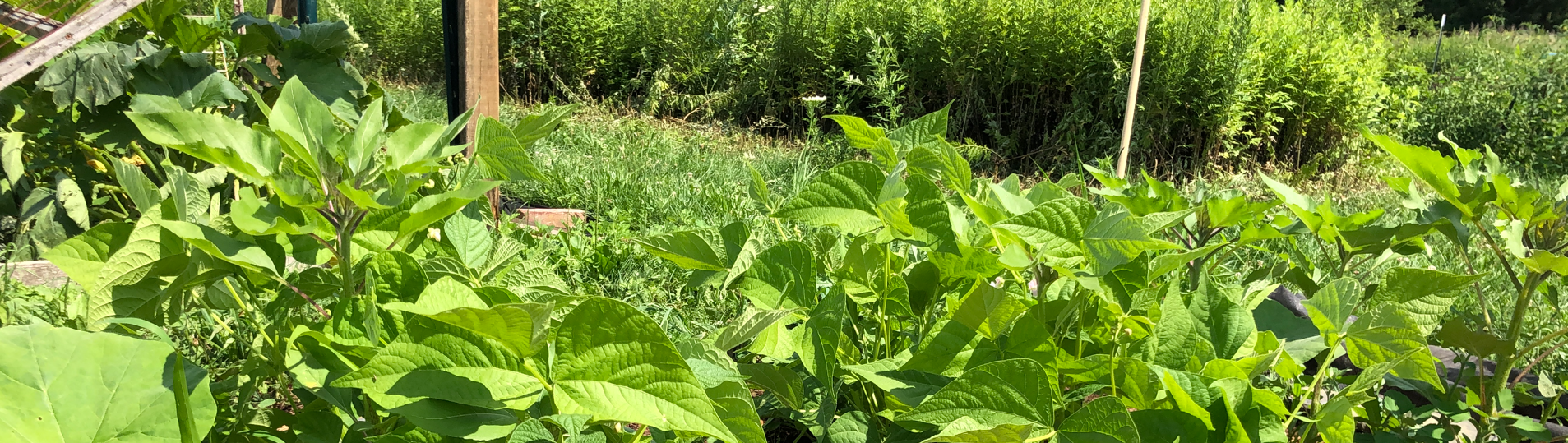
The most fitting way to say what Umoja Unity Gardens are about is to share part of the celebratory speech that was delivered at the planting of the first Umoja Unity Garden. Following is most of that speech.
“Most of you [here today] know different pieces of the garden’s story. But it seems fitting to briefly recount the history of how the garden came into existence so no one is missing any pieces. In my mind, the story of the garden began when Ron and Louis invited me into their family and eventually to my first-ever Seder. Over the years, before I ever made it to that Seder, I watched them take many people into their family. The one I was most struck by was Dumi. He was a student from Africa who they invited into their home and eventually adopted. For years, I failed to fully understand such large-hearted generosity.
Then two years ago, a friend of mine, Steve Mendelsohn, invited me to a virtual Seder held by the Black-Jewish Alliance in Philadelphia. At every element of their Seder, they recounted both the pain of the Jewish journey out of slavery but also of the African-American journey out of slavery. It is hard to explain how much that mutual sharing of pain affected me, except to say a little about how I saw the world as a child.
When I was younger, I had a simple worldview. There were whites and there were blacks. I knew that some white immigrants were viewed negatively. But I also knew that many people jumped that hurdle be simply blending into the crowd. They Americanized their strange last names, they quite speaking their native tongues, they straightened or dyed their curly hair. In other words, they did the same thing some light-skin black people did. They did what they need to do to “pass” as real Americans. If for no other reason than that it just, made, life, easier.
I know that being Jewish can have both an ethnic aspect and a religious one. So not all Jews are white. But many of them are white. Given that fact, I could not understand why so many of them would put a target on their back by trying so hard to help blacks and other oppressed people when they could have blended in, kept their mouths shut, and gone about life without caring much about anyone else but themselves.
What the Black-Jewish alliance Seder finally made clear to me was that the pain of their journey had changed them in a much different way than I was used to seeing. It could have made them bitter, guarded, and self-absorbed. Instead, the pain of their journey had made them more human, not less; more willing to embrace the risk of help others, not less; more socially concerned, generative, and caring and not less so. Somehow, they had taken what should have been a curse and turned it into a blessing.
Once I understood that, I began to wish that as African Americans we, too, had a ceremony of our own that could help us remember our pain as not merely a curse but in the long run also as a blessing.
It was in that spirit that I penned the proposal [on our homepage] to Northampton Community College’s East Forty.”
You can think of an Umoja Unity Garden as a “Garden Seder” that can be celebrated whenever the garden is planted, tended, or harvested. Just as in a Seder, each element has meaning. We chose seven elements because seven is the classical number that represents human perfection.
- The first element is the idea of Umoja itself, a type of unity that African’s understand as HARMONIOUS DIVERSITY – not diversity for diversity’s sake, but because diversity works to make the whole better. To remind us of this principle, all the plants in our garden are planted using the companion planting technique. Onions and carrots are planted together so that the onions can protect the carrots from parasites. Potatoes, garlic, and basil are planted at one end of the garden for the same reason. Sunflowers, beans, and squash are planted at the other end where sunflowers provide the beans support and squash supplies ground-cover to prevent weeds from swallowing the other two.
- Red marigolds and beets were planted to remind us of the BLOODINESS OF PHYSICAL VIOLENCE within slavery.
- Garlic and Onions represent the BITTERNESS OF EMOTIONAL AND SPIRITUAL VIOLENCE that is inherent in oppression.
- Carrots and basil symbolize the SWEETNESS OF FREEDOM found in extended family and true village community.
- HOPE AND NEW BEGGININGS are conveyed by potatoes and beets, because they supplied dependable sustenance to many enslaved people through the winter of their oppression.
- Sunflowers, and also marigolds, represent BEAUTY AND STRENGTH – the beauty that displays itself in people and life, even amid great difficulties, and the strength of character it takes to remember the beauty is there and to survive.
- HUMILITY AND OUR COMMON HUMANITY are symbolized by the ground in which our garden was planted – the humus from which we come and the dust to which we will return.”